Let's Talk About That Speech
Vulnerabilities, Entrenchment, and What We Can Do About It

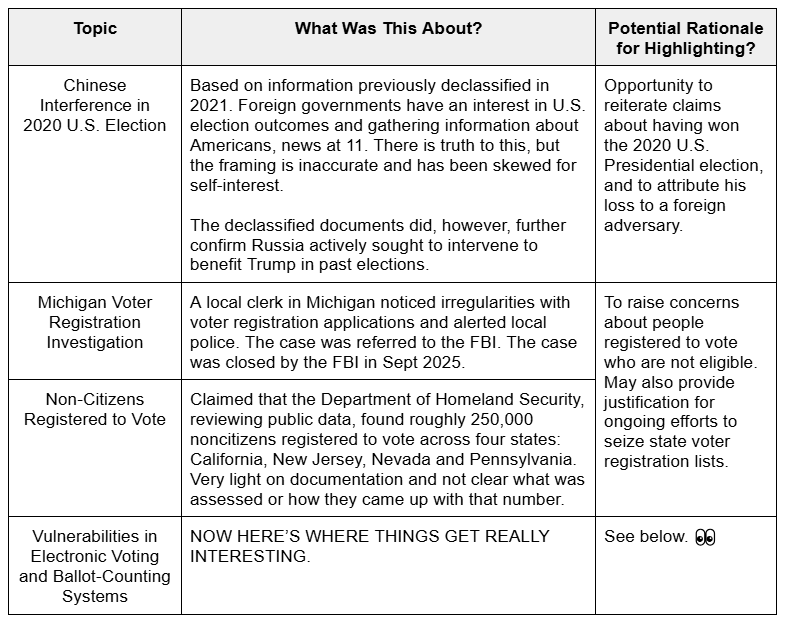
On Thursday July 16, the President of the United States gave an address to the nation regarding U.S. elections. In this speech, four key topics were highlighted:
Claims of Chinese Interference in 2020 U.S. Presidential Election;
A Michigan Voter Registration Investigation that began in 2020;
Claims of Roughly 250,000 Non-Citizens Being Registered to Vote; and,
Vulnerabilities in Electronic Voting and Ballot-Counting Systems.
Each topic was accompanied by associated ‘declassified’ documents published on the White House website. Much of this information was in fact already declassified, had never been classified, or was already public knowledge through other channels. The address ended with a call to action for members of Congress to pass the SAVE America Act into law.
The response has been, predictably, polarized. One narrative is that this release of classified information demonstrates interference in the 2020 U.S. Presidential election and makes a case for future potentially extraordinary measures – including new legislation – in the upcoming midterm elections. Another narrative is that the entire speech is nothing but lies and everything he said must be dismissed as false.
The reality is less clean cut. Here’s our take.
Let’s take this by topic area, but leave the most interesting for last.
Vulnerabilities in Electronic Voting
and Ballot-Counting Systems
This was, by far, some of the most surreal portions of the address for our team to hear – and not for the kneejerk reasons pushed across independent and legacy media, influencers, and online commentators in the aftermath.
Put simply: there is a whole lot of evidence to support these claims predating the information being leveraged by the President this particular moment.
Yes, There Are Vulnerabilities
If you’re familiar with ETA, you’ll know that we are clear-eyed and vocal about the vulnerabilities inherent to America’s computerized voting systems. We’ve done multiple videos about it and posted multiple briefings/resources on the topic. (Here are a few to get you started.) We’ve also been direct about our concerns regarding possible compromises of those systems in the 2024 U.S. presidential election, as a result of both concerning statements made by political operatives and patterns in the data consistent with vote manipulation. We called on the Pennsylvania Secretary of State to launch an investigation after Trump’s comments about Elon Musk’s familiarity with “vote-counting computers” in Pennsylvania. We undertook our own analysis for which the findings laid the basis to file a lawsuit seeking hand counts of paper voting records and enhanced protections for future elections, which is still making its way through the courts.
It is an empirical fact that these vulnerabilities do exist. Cybersecurity experts have been raising the alarm about America’s insecure voting infrastructure for decades. Officials and experts across the political spectrum have repeatedly affirmed this, albeit generally with the stipulation that there is no definitive proof of successful alteration of votes taking place. There are known vulnerabilities, and there have been successful efforts to breach them; however, without a full hand recount (with rigorous chains of custody, observed by independent witnesses) it is not possible to determine whether these efforts affected election outcomes.
The President’s proposed remedy of passing the SAVE America Act is unlikely to resolve the documented vulnerabilities inherent to the machines used to cast and count votes. Requiring proof of citizenship to vote would do little to change the fact that, after a vote has been cast, it is still vulnerable to being manipulated or miscounted.
Why Were These Vulnerabilities Highlighted?
There are a few potential reasons behind disclosing and highlighting these vulnerabilities.
Presented without comment, here are some of the most common potential reasons we have seen proposed and discussed online since the speech:
Addressing those vulnerabilities and protect future elections, including by interference from foreign governments (whether or not the proposed remedy would achieve that goal).
Appealing directly to the Republican base, many of whom have raised concerns about these vulnerabilities for years and often met with scorn and skepticism for doing so.
Signposting a need for ‘extraordinary measures’ to be taken in relation to the upcoming midterm elections, particularly if it appears likely that those election results will be unfavorable to the incumbent administration.
Lining up an excuse for why Republicans may underperform in upcoming elections.
Advancing an anti-establishment ‘deep state’ narrative by arguing “they hid this from you.”
Laying the groundwork to contest unfavorable midterm or subsequent election results by manufacturing the justification to lay the blame at the feet of a foreign adversary.
Causing confusion and chaos in an effort to use whatever methods may be needed, legal or illegal, to ensure his party retains power in upcoming elections.
Regardless, let’s take a step back, tune out the noise, and focus on one profoundly under-discussed impact of Trump specifically being the one to speak about these vulnerabilities.
The Kneejerk Pushback
Donald Trump is a famously polarizing figure. His most ardent supporters view his statements and positions as more trustworthy than experts or the establishment.
In contrast, those that position themselves in opposition to his politics are often predisposed to reject what he says as untrustworthy, as evidenced by the numerous posts and videos from well-known public figures shared before the address pre-emptively urging the public not to trust whatever was going to be said.
For these people, the legitimacy of these security vulnerabilities, and the real threats they pose, are automatically discredited because of who is talking about them rather than the evidence behind them.
This is not the first time we’ve seen this happen. The impacts of 2020 Stop The Steal have been long-lasting on public discourse. Post-2020, the mere concept of raising election integrity concerns became so politically toxic in many circles that to this day candidates and media personalities refuse to acknowledge they exist for fear of “appearing conspiratorial” or “sounding like an election denier”. Although this refusal to confront or even critically consider these vulnerabilities goes back long before 2020, that election was a watershed moment that deeply entrenched this default position in the public mind.
When legitimate concerns were raised in the aftermath of the 2024 election – bomb threats, statistically and historically improbable outcomes, concerning statements made by key actors before and after the election – the visceral pushback to those concerns being raised was staggering. Our organization was born in the churn of this period, where “our elections are secure” was used to dismiss valid concerns and calls for investigation just as much, if not more, than the “he won, get over it” refrain from those on the right.
We fear that, in response to the Thursday address, a less immediately obvious but just as damaging outcome will be ever-louder proclamations that these systems are secure, despite documented evidence that they’re not.
There are serious risks and dangers here, particularly if voters and candidates become too entrenched in that view to call for recounts or audits in future elections… even in cases where there are ample red flags.
Per a post-speech interview with election security expert Marilyn Marks, a lot of this kneejerk reaction is coming from progressive groups: “Right now, the progressives are so caught up in defending the system that they are not ready to say ‘yeah, let’s protect the system now’.”
So What Can We Do?
There is a dangerous entrenchment occurring and a substantive rhetorical barrier to overcome that cannot wait until November. It is being waged now, in the minds of regular Americans and candidates alike, in the comment sections of social media posts and in how these topics are covered in the nightly news.
There are so many things that can be done to make U.S. elections safe and secure that go beyond security theater. It is genuinely a question of whether or not there is the resolve and courage to make it happen.
This may feel like a moment of chaos, but within the churn is a genuine opportunity for inflection and organizing. In assessing where best to put our energy, let’s remember our two evergreen principles: 1) independent oversight for elections is critical; and 2) verify the vote, every vote, every time.
Push Back on Kneejerk Responses That Dismiss Systems Vulnerabilities
Two things can be true at once. We can push back on falsehoods without relying on them ourselves, particularly when the result may be to entrench ourselves in a harmful position it will be difficult to disentangle ourselves from later. Check out our latest video on 5 Urgent Tips to Protect Election Integrity (Without Giving Ground On Security) for advice on how to avoid common traps.Demand Federal Money For State/County Hand Counts
Taking these concerns at face value, the federal government should provide financial capacity to state and local governments to enable them to hand count every vote.Join in the Push For Hand Counts and Election Security Locally (With Rigorous Chains of Custody, Observed By Independent Witnesses)
The decentralized nature of U.S. elections means that every fight to verify the vote is local. That said, there is much we can learn from each other about what works and what doesn’t. Citizen groups in different states advocating for hand counts and enhanced security measures could have a real impact where it matters most. If you have ideas for what this could or should look like, email us at help@electiontruthalliance.org with the subject line “Organize For Hand Counts”.Call on State and Local Officials to Invite Independent Election Observers
Inviting international election observers from organizations like the United Nations and from other countries are common practice in elections all over the world, and can increase confidence in the process by having a neutral, non-involved party present to observe proceedings and report on concerns after the fact.Sign Up To Be An Election Observer or Poll Worker Yourself
Many states have laws allowing regular people to sign up to be an election observer at your local polling place. Our friends at SMART Elections have a non-partisan election verification program, #CountTheVote, that is is helping to teach observers across the country to monitor and protect U.S. elections. You can sign up for #CountTheVote with SMART Elections here. At the time of posting, they have over 800 observers signed up in 47 states — but we can make that number bigger!
Appeal to Shared Values
There’s a moment to find common ground here across political lines. Despite any differences, all Americans want their own votes to count – and to be counted accurately. Let’s appreciate that shared value and use it as a starting place to foster real change.
—
What can we do, as individuals and groups, to move beyond “defending systems now” and into protecting elections in future? Leave your thoughts in the comments below.
Share this article widely.
Check out our website to learn more about our organization and how you can support our work.
Note: This article was updated on July 19, 2026 to further specify that hand counts of paper ballots should be observed by independent election observers, and to add links to information for the #CountTheVote program.
To digitally alter vote totals in ways that couldn't be detected, even with an audit no matter how deep they went>
Donald Trump
This was the important statement because he always tells on himself.
State election laws must be updated. In a world of Peter Theil, Elon Musk and other democracy-despising broligarchs, our electronic vote counting systems are vulnerable. We can no longer have recounts based on margin of vote wins; those are just hacker targets to meet. In MD, you can't ask for a recount if the wining margin was 5% or more. Requestor has to pay for the recount and request it within 3 days of official results. The evidence shows that unexpected winners had margins that exactly met and did not exceed the recount threshold. Our Laws should require automatic forensic audits of big money, highly competitve races (primary or generall) by non partisan, non profit, independent entities (ETA, This Will Hold or other). If anomalies appear in the data analysis, a 100% paper ballot recount should be automatic regardless of win margin. Localities should be training citizens cadre of pollwatchers as well as election judges. Get rid of requirements that cannot tell us what we need to know post election, sample based vote count audit for example. Each state should hire its own machine certification company and certification findings be made public (current national certs are paid for equipment makers and results proprietary). We should be prepared for governors to use emergency powers this fall if election outcomes do not seem right. The regime seems genuinely scared that the size of their loss will be to big to manipulate the count everywhere in all the new swing districts, which is why they are hellbent on suppressing dem and independent voters. But we shouldn't rely on turn out to overcome all evil. Eyes wide open please. Please also note that evidence indicates mail in ballots harder to manipulate...wonder why Trump wants to ban it?